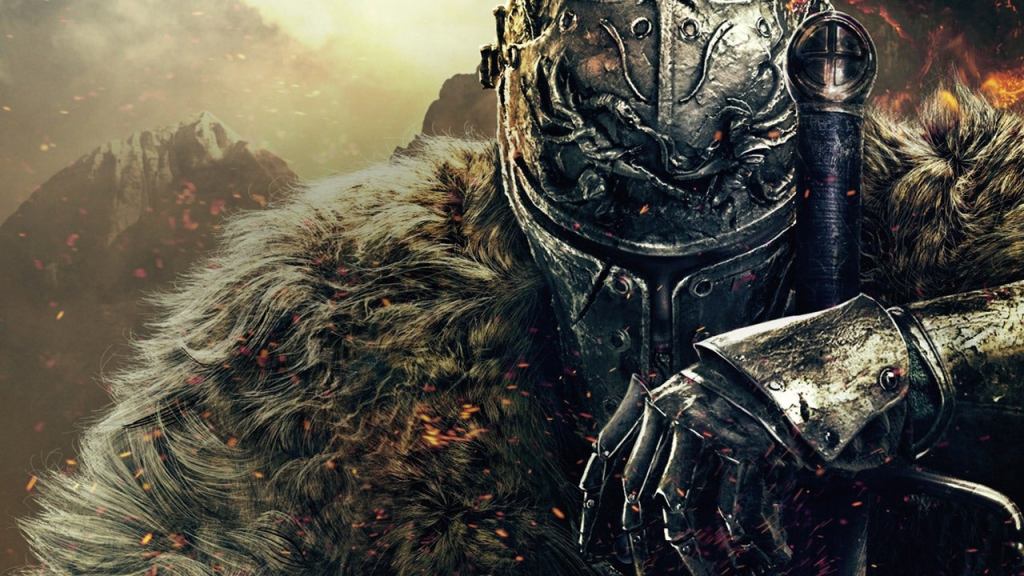
The soulslike genre has been a topic of debate within the gaming industry since its incarnation in 2009, when FromSoftware released Demon’s Souls on the PS3. The difficulty of these games has been raised as an issue by many, but by those that love these games, is a feature that simply cannot be compromised on. At the end of the day, it’s the difficulty of these games that has placed them in a genre of their own right, and something that I personally have grown to love. I think that the debate around these games shows a bigger problem within online gaming communities, and in today’s blog, I’ll be diving into all the factors and opinions at play when questions like this. I’ll be honest, I don’t really intend on answering the leading question of today’s piece, but more looking at the general conversation around these games.
Time for a history lesson (don’t blame me, everyday’s a school day, and I feel it’s only fair that I in some way contribute to your daily learning for today). As stated in the introduction, the soulslike genre was born in 2009, with the release of Demon’s Souls. The game released to a generally good reception, reviewers felt that while the game was difficult, with some difficulty spikes that could be seen to be generally “unfair”, the reward offered to the player in completing these sections made the game extremely fun, and “one of the best PS3 exclusives on offer”. The game sold modestly well, with over a million copies sold as of two years after its release, it was seen to be a success in the eyes of FromSoftware, who would go on to make some of my favourite games.
Maybe you’re reading this and you have absolutely no idea what a soulslike game is. Well let me explain generally (going into the finer details would probably take me an hour or two to explain, and let’s be honest, if you had that amount of time to read all about that you either love this genre and therefore, already know what it is, or you need to go outside and find something slightly more worthwhile to do in your spare time). The defining feature of the soulslike genre is the difficulty of the games within the genre. The game structure sees semi-open levels (although the game structure is very linear), where the player moves from checkpoint to checkpoint, fighting through enemies and finding loot in chests or on the ground. Eventually, each section reaches a climax with a difficult fight against a boss, and then the gameplay loop repeats.
One of the magical things that come with games in this genre is the level design. This is a staple in the majority of the games found in the soulslike genre, where thorough exploration can lead to shortcuts being unlocked. Getting from checkpoint to checkpoint is a difficult task, as even basic enemies can be a difficult task to get through if ganged up on by multiple. The feeling of satisfaction that comes from opening a shortcut is an addictive feeling that set these games apart from others, as it is rare that merely reaching a checkpoint, as well as unlocking a shortcut to get to the next can give the player such satisfaction.
The other huge gameplay feature in these games are its bosses. These are, without doubt, some of the greatest boss fights one is ever likely to encounter in the gaming industry. Each level builds to the boss fights, and they’re difficulty is understood by the developers, who will generously place a checkpoint near the fight so the player doesn’t have too much to do before fighting the boss. These fights test the player’s ability to react to the bosses moveset, and are a battle of attrition. From personal experience, the tension felt throughout these fights, especially when you’ve been beaten time and time again, is like nothing I’ve experienced in gaming anywhere else. And when the boss is eventually beaten, the feeling of pure unadulterated joy is unmatched, and it is that emotional response that makes me truly love these games.
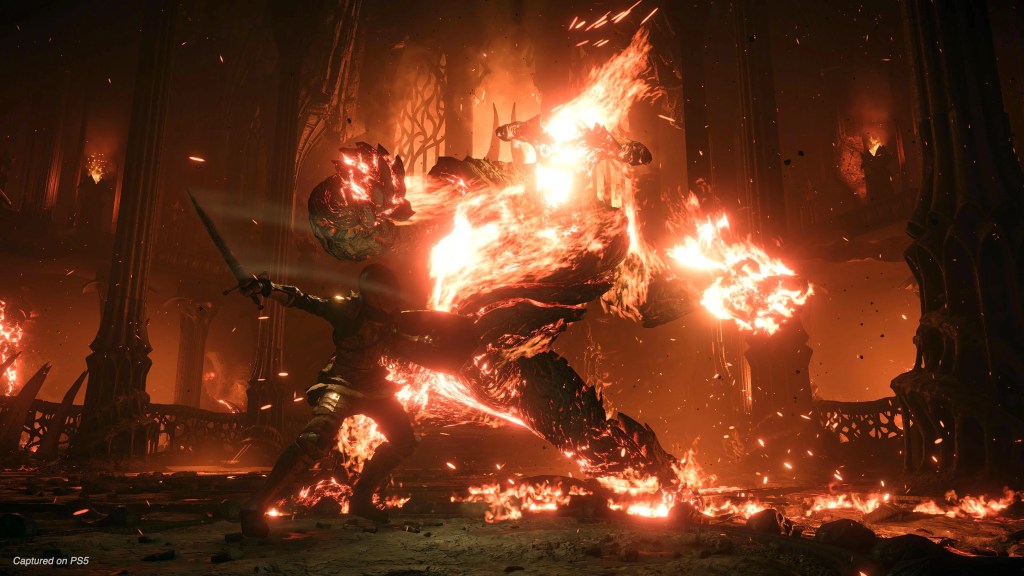
Bosses are one of the key features of any soulslike, requiring the player to learn specific patterns in order to defeat them. Pictured here is Flamelurker, considered to be one of the hardest bosses in Demon’s Souls (2009), which sparked the beginning of the soulslike genre.
Throughout this post I’m going to focus on five huge players in the soulslike space: Demon’s Souls, the Dark Souls series, Sekiro: Shadows Die Twice, Elden Ring, and the only non-FromSoftware title in the list, Nioh. FromSoftware are without doubt, the leaders in the soulslike space. They were, after all, the innovators, and from which the inspirations for many many titles comes from. When they brought out Demon’s Souls in 2009 it was a huge gamble that ultimately paid off for them. And the interesting thing is that it wouldn’t be this title that would be heralded, but their next title, Dark Souls.
Demon’s Souls was the first foray into this space for FromSoftware, and with the Bluepoint 2020 remake releasing as a launch title on the PS5, it became clear (through the power of hindsight), that many lessons were learnt from this game, which led to the crafting of the three games in the Dark Souls. The overall structure of Demon’s Souls differs massively from the future titles FromSoftware would make, with a world and level structure that could be simplified to the structure of the Super Mario Bros games (Level 1-1, 2-1, 2-2 etc), Well, I say that, but it isn’t really representative when I think about it, and just a way to explain the structure.
The game is set in Boletaria, and when beginning the game you must complete the first section of the first world (or level 1-1 as it were). Personally, I played the 2020 remake and so can only speak on that version of the game, but you start at a huge castle area, with the first level being particularly long. Eventually you reach the first boss, an underwhelming fight but ultimately serves like a tutorial. Phalanx is a boss who is negatively affected by fire, which is something the game preps you for. Throughout the route to the boss, you pick up lots of fire bombs and different fire related items, and in this moment that the player understands that paying attention to what you are given is hugely important.
Once you’ve beaten Phalanx, you are given access to four other worlds, which you can complete in any way you wish. Some players choose to play the first section of world two, then the first section of world three and so on. Others may go straight to world four first. It really was up to the player what order they would complete the game in, which was a level of freedom that wasn’t seen in FromSoftware games again until Elden Ring (we’ll get onto it later).
Demon’s Souls was a great first attempt, but there were some flaws that were changed for future titles. First of all, there were no checkpoints in between levels. Players had to complete the full level before reaching the boss, and should they die before they reach the boss they get thrown right back to the start. The key was to unlock shortcuts in order to shorten the journey to the boss. This meant, in many ways, that the game was comprised of numerous roguelike levels. Secondly, the bosses in the game were all relatively easy compared to what we would later see in the genre. Many of the bosses had a gimmick to defeating them, and with the exception of two notable fights, were often forgettable. FromSoftware would learn from this and massively improve the quality of their boss fights.
Delighted from the success of Demon’s Souls, FromSoftware would begin the development process of Dark Souls, the series that would being the cult following that comes with the soulslike genre. These games are accepted to be more difficult than Demon’s Souls, however the introduction of the bonfire system (each level had multiple checkpoints before reaching the boss), gave the player much more scope to explore the level and find its many secrets. This led to a couple of factors. Firstly, exploration became a key part of the Souls franchise, as beneficial items were often found off the beaten track, and secondly, the bosses were much much harder. Bonfires were usually always placed a stone’s throw away from the boss, meaning the player had a short journey to repeat the fight time and time again. And for most players, it really was time and time again.
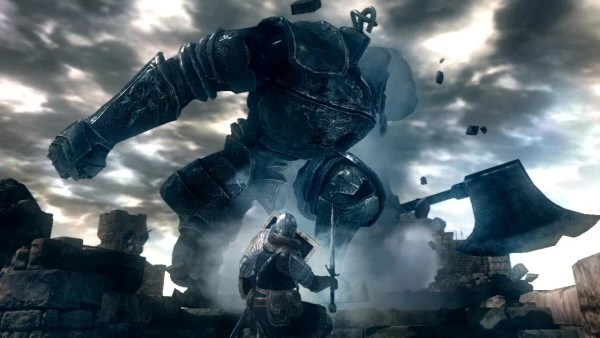
The success of Demon’s Souls would lead to the birth of Dark Souls, the three game series that was instrumental in bringing the cult following the soulslike genre has today.
The difficulty spikes encountered in Dark Souls were unlike anything that had been experienced in the industry before. Bosses would take many many attempts to beat, and with some level designs being intentionally “janky” (poison areas belong in a special place in hell), some players were starting to question if these games were just being difficult for the sake of being difficult. When it feels as though the odds are being stacked unfairly against a player, it is then that, in my view, the difficulty debate is valid. And I think that it’s fair to say there are some areas in these games that are designed to just be a hindrance.
As for the bosses themselves, these are often balanced in my view. Every death against a boss provides the player with new information, which they can take onto the next fight. For me, deaths to bosses occur when the player gets too greedy, makes a mistake, or is blindsided by a move they are yet to see. It is understanding this that leads to the conclusion I will be coming to later on in this post.
Of the Souls series, Dark Souls 3 is the game that I’ve played the most, and it was my first experience of the genre. When I got my PS4 in 2018 (I got it second-hand, and it would get me through most of my time at university), a friend of mine encouraged me to get Dark Souls 3, saying I would love the combat, and the boss fights. The game was actually on sale at the time, so I picked it up relatively cheaply and began on my way. Well, I would only stick with the game for an hour, being pummeled by the tutorial boss, Iudex Gundyr, over and over again. I turned the game off, and swiftly deleted it in a fit of rage.
“I would only stick with the game (Dark Souls III) for an hour, being pummeled by the tutorial boss over and over again. I turned the game off, and swiftly deleted it in a fit of rage.”
I would move on to play Star Wars: Jedi Fallen Order, a game I would complete in a matter of days, where the parry-focused combat suited my style of play, and the boss fights being just at my level. This might not seem overly relevant, but it was because of this game that I would pick up Sekiro: Shadows Die Twice, and excel at it. Sekiro was FromSoftware’s next project after Dark Souls, and was a higher paced game, where combat focused on parrying and depleting the stamina of enemies and bosses alike, before delivering a swift killing blow. Jedi: Fallen Order trained me as a young padawan in the ways of parrying, before Sekiro would ultimately work to train me in becoming a master of the craft.
Sekiro remains my favourite of the FromSoftware titles, where swift combat over everything else gives the game such a thrilling feeling as you race through some of the best boss battles FromSoftware has to offer. I’ll never forget playing through the first area and reaching what can only be described as a desolate battle field, and hearing the cry “My Name Is Gyoubu Masataka Oniwa” before facing one of the best early-game bosses there’s ever been. When I first played the game it took me many, many attempts, but now, having learnt so much more, very rarely will it take me more than one or two attempts. That’s the thing with Sekiro. The game teaches you to be better (or git gud as many people remind me in twitch chat on a weekly basis), and I feel that Sekiro is the best at doing this.
There are very few games that show the player that they are better at the game as they progress, but Sekiro does this is in a way that ultimately provides a level of satisfaction very few games can provide. A pivotal moment for me, comes in the first fight you have against Genichiro, quite possibly one of my favourite boss fights ever. This fight is a skill checker for the player. Ultimately, if you cannot beat Genichiro, then you are not ready for the rest of the game. When I first played Sekiro, it took me over 2 hours of repeated attempts to beat Genichiro, but the feeling of achievement in beating him is an unmatched feeling, and what truly made me fall in love with the game.

Sekiro: Shadows Die Twice remains one of my favourite games to play over and over again, mainly due to the rhythmic and rewarding nature of the combat.
FromSoftware’s next venture would become one of the most talked about games of all time, as they joined forces with legendary Game of Thrones creator George R. R. Martin to deliver Elden Ring, easily one of the most ambitious games ever made. The hype behind this game was huge, and as the game reached its review season, we all watched in awe as journalism outlet after journalism outlet would give the game a perfect 10 score (it is the highest rated game of the year on Metacritic, scoring 96). The game was praised for the freedom offered to the player in its content-rich open world design, and the introduction of a jump mechanic (this had not been seen in FromSoftware’s other soulsborne entries, apart from Sekiro) added a new wave of combat options.
I bought Elden Ring and downloaded it onto my PS5 on launch day, getting up at 6am on Friday morning to play for two hours before work. And my mind was truly blown by the sheer scope of the world and what it had to offer. The art style was stunning, and the world was so densely packed that I never felt as though I was roaming the world doing nothing. I would be heading towards an objective and would get completely side-tracked by something that would catch my eye, only to return hours later, finally back on the main path of the game. This was a feeling I thought would disappear over time, but in the 45 hours I’ve spent playing the game this feeling never left me.
The size of the game meant that in many ways, this was one of the easier of FromSoftware’s titles, as the player could level up well above and beyond expected before facing a “main-line” boss. This became true in my playthrough, sometimes leading to underwhelming fights. After all, I play these games and expect to be beaten multiple times by bosses before continuing, that is part of the addiction with these games, but I only encountered this once. Facing Margit, the first main story boss, was a terrifying experience, and the number of times he told me to “put these foolish ambitions to rest” was more than enough to make me want to cry quietly into the sofa and break my controller (quick disclaimer my controller was not harmed in the playing of Elden Ring). However, the elation felt after beating him is something no other genre can deliver.
A game I have recently started playing is Nioh, probably the only non-FromSoftware soulslike title I’ve had the pleasure of playing, and I must say that I have been thoroughly enjoying it. It is clear to see the inspiration from the Souls series, as the game follows many of the tropes from those games, but it must be made clear that it has many more original mechanics and ideas that set it apart. The combat is fast-paced and requires careful decision making when it comes to the stance mechanics, and I have found that individual enemies are more difficult than my experience with Souls games. The satisfaction from beating bosses is very much at play here, and overall I feel that Team Ninja were extremely successful in creating the vision they had for the game.
Finally, without trying to come across as snobbish, or controversial just for the sake of it, it is my opinion that the difficulty of soulslike games are blown out of proportion. I do agree that the games are hard, that is absolutely true. However, I think they teach players so much about staying calm under pressure, and patience, that often the difficulty experienced by players is due to their lack of willingness to understand the game. When I started playing these games I was absolutely awful at them, but the more and more I tried I got better and better, to the point where I find them relaxing.
“I think they (soulslike games) teach players so much about staying calm under pressure, and patience, that often the difficulty experienced by players is due to their lack of willingness to understand the game.”
I totally understand that these games aren’t for everyone, no game is, and me saying that the game can be made easier just will not apply for everyone. But the discourse online about the lack of a difficulty option in these games comes from a group of people who simply do not understand what the core fundamentals of the game are. The game isn’t designed to be hard in a way that’s unfair. They’re designed to teach the player to be resilient, patient, and calm, skills that are helpful to us all in everyday life.
I personally love the soulslike genre. I think it provides a level of satisfaction that cannot be matched in many other games, and requires the full attention of the player. And while the story is nonsensical (I’ve attached below a clip of streamer Maximillian Dood with his impression of the story of Dark Souls, it’s very informative), the setting and combat encounters more than make up for this. These games rank among some of my favourite, and I look forward to seeing what the future has in store for the soulslike community.
 Gaming Ramble Weekly
Leave a comment